The Month in Review.
Second issue · October 2026. A monthly review of the Wisconsin Supreme Court—what the Court has just done, what is at stake, and where to read further. This issue recaps the eight oral arguments heard between September 8 and September 23, the Planned Parenthood complaint filed in Dane County, and commentary on Wisconsin ‘Judge’ Hannah Dugan.
The Wisconsin Supreme Court heard eight arguments between September 8 and September 23, and in most of them the justices were asked to supply a rule that neither the Legislature nor the parties had written. It was, as this issue puts it, a term’s worth of method questions compressed into one sitting. How the Court answers them will say more about the term than any single outcome.
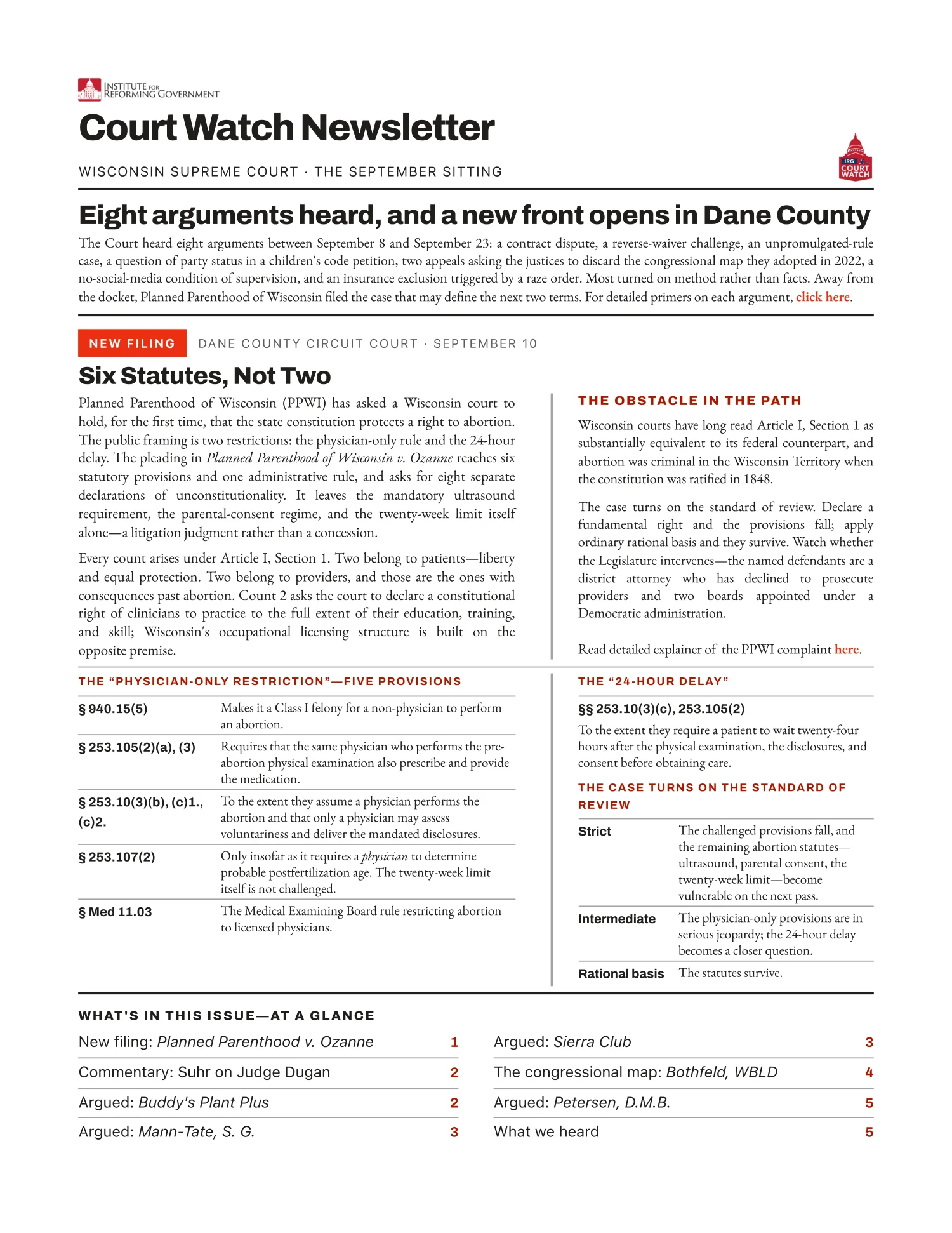
The filing that may define the next two terms
Away from the docket, Planned Parenthood of Wisconsin asked a Dane County court to hold for the first time that the state constitution protects a right to abortion. The public framing is two restrictions; the pleading reaches six statutory provisions and one administrative rule and seeks eight declarations of unconstitutionality. Two of its four counts belong to providers, not patients — including a claimed constitutional right of clinicians to practice to the full extent of their training, a premise Wisconsin’s occupational licensing structure is built against. Everything turns on the standard of review.
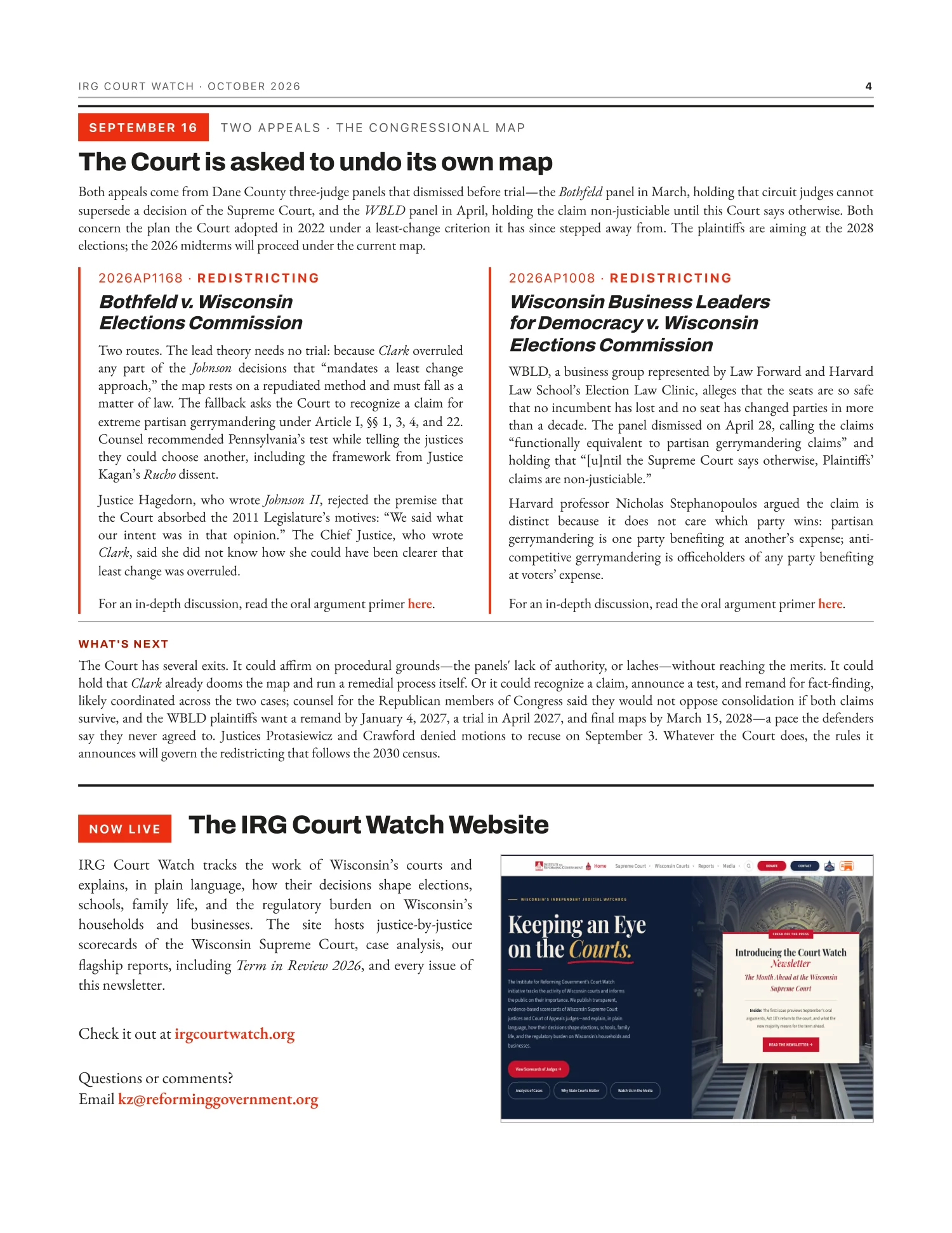
The Court is asked to undo its own map
Two appeals argued the same day attack the congressional plan the Court itself adopted in 2022. Bothfeld argues the map rests on a method Clark repudiated, with a fallback asking the Court to recognize extreme partisan gerrymandering under Article I. WBLD presses a distinct anti-entrenchment theory: not which party wins, but whether anyone can lose. Both panels dismissed before trial. The 2026 midterms proceed under the current map.
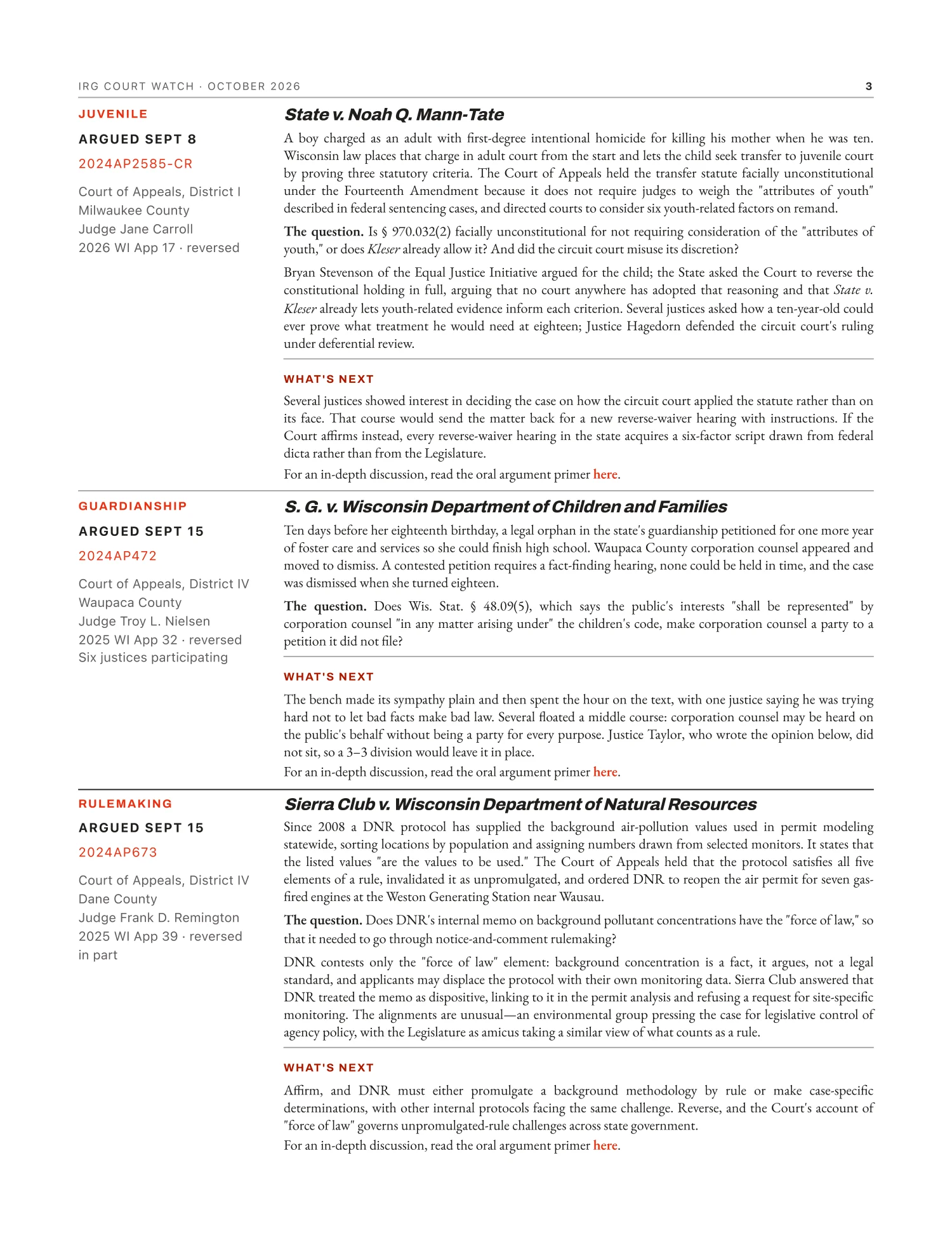
Six arguments, one recurring question
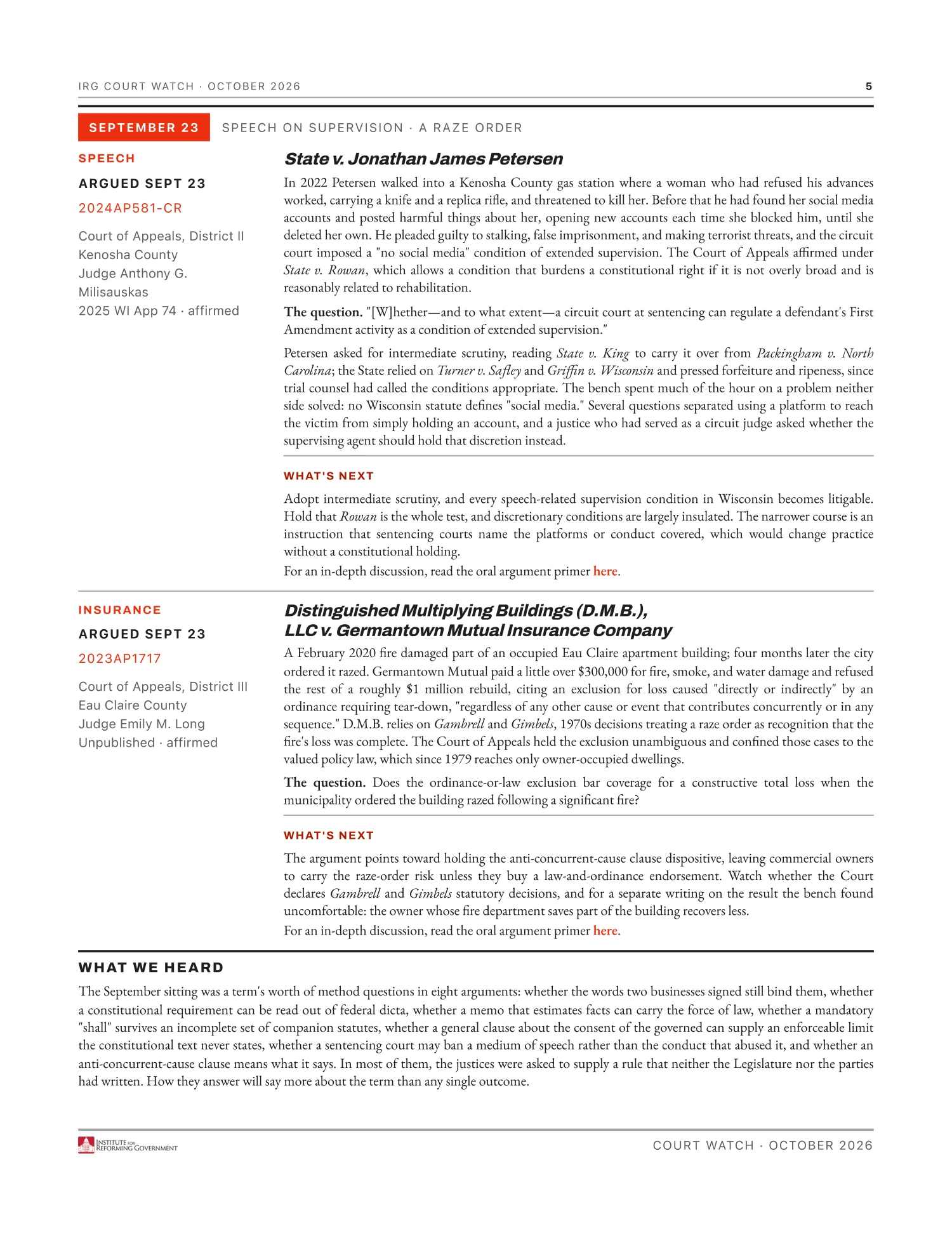
Whether the words two businesses signed still bind them (Buddy’s Plant Plus); whether a constitutional requirement can be read out of federal dicta (Mann-Tate); whether a memo that estimates facts can carry the force of law (Sierra Club); whether a mandatory “shall” survives an incomplete set of companion statutes (S.G.); whether a sentencing court may ban a medium of speech rather than the conduct that abused it (Petersen); and whether an anti-concurrent-cause clause means what it says (D.M.B.).
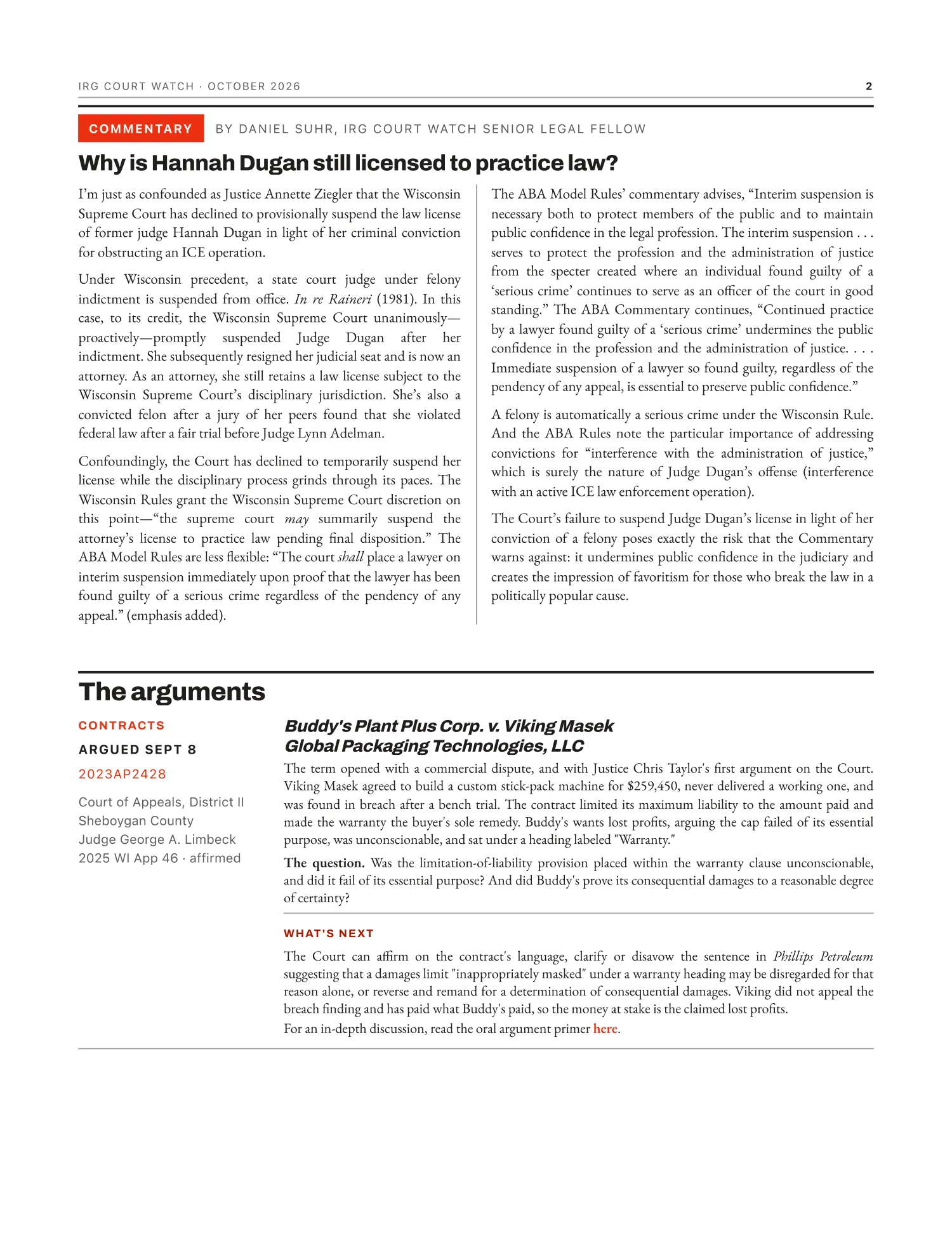
Commentary
Senior Legal Fellow Daniel Suhr asks why Hannah Dugan still holds a law license. Wisconsin’s rule leaves interim suspension to the Court’s discretion; the ABA Model Rules make it mandatory on proof of a serious crime, regardless of appeal. Declining to suspend, he argues, creates exactly the impression the commentary warns against.
Detailed primers on all eight arguments are collected at Oral Argument Primers — September 2026, and the Planned Parenthood complaint is unpacked in Six Statutes, Not Two.